

The Collectorosophy Development Framework: An Example
Collectorosophy explicitly rejects the notion that understanding must be inherited, purchased, or gatekept. Instead, it recognises inexperience as a necessary and productive stage of collecting, provided it is engaged with intentionally. The following framework offers a practical pathway through which emerging collectors can catalyse their understanding of a field while minimising error, reducing dependency on authority, avoiding unfocused acquisition, and building a communal space in which to share their journey.
Phase I: Orientation — Skill and Knowledge development
Primary objective: Visual and material familiarity to build restorative practices
At this stage, the collector is not attempting mastery, but exposure. The emphasis is on:
Handling and observing as many objects as possible (museums, collections, fairs, study groups).
Developing a visual vocabulary: forms, proportions, construction methods, finishes, and wear.
Accepting uncertainty and resisting definitive attribution.
Reading source material and gathering a library of resources to draw from.
Drawing knowledge and understanding from advanced collectors.
Low-cost, incomplete, or flawed objects are particularly valuable at this stage, as they allow repeated handling and comparison without financial intimidation. Collectors are able to position themselves to reduce the fear of damaging higher-end antiques. This enables the development of restorative processes, through which an understanding of metallurgy and age-related material change can be expanded.
This step allows collectors to extract far more value from “lower-end” pieces and develop familiarity with restoration, patterned steels, and conservation. It also provides an opportunity to practise restorative and conservative approaches to objects that might otherwise be incorrectly deemed “valueless” due to a lack of intrinsically high-value features such as precious metals or elaborate decoration.
The final and most important aspect of this initial phase is the gathering of knowledge and reference sources. These resources build expectations of what to look for and what to anticipate. While much of the available literature focuses on higher-end examples and therefore becomes more practically useful at later stages of collecting, it nevertheless establishes an aspirational benchmark for what a collection may grow toward.
Phase II: Constraint — Establishing Scope
Primary objective: Discipline through limitation and sequential expansion
Once basic familiarity is achieved, intentional constraints are introduced:
Narrowing focus by period, region, typology, or material.
Explicitly defining what lies outside the scope.
Increasing the quality or level of pieces acquired through iteration.
This phase prevents indiscriminate accumulation and forces depth over breadth. Importantly, scope is provisional; its purpose is to train discernment rather than permanently fix collecting identity. This is an ideal stage to explore the range of weaponry that Indo-Persian arms and armour offer.
This approach is not limited to a single culture and allows comparative understanding of different cultural swords using the same principles. Scope may evolve as a collector’s interests grow and mature, helping to prevent impulse purchasing and regret over undesired acquisitions.
Phase III: Interrogation — Critique of Unsubstantiated Authority
Primary objective: Critical engagement with examples, sources, and literature
The collector begins actively testing claims by:
Comparing your own pieces and dealer descriptions against known examples, primary sources, museums, and historic cultural preservation efforts, rather than relying on a single source.
Identifying where attribution is asserted rather than demonstrated, including assessing metallurgical structure, decorative metal oxidation states, and the overall quality or crudity of an example (to name a few).
Recognising authority bias and prestige-based validation.
This phase marks the transition from passive acceptance to analytical engagement. Collectors begin focusing on more objective features of a sword- that can be objectively measured, comparing known examples and literature to make informed decisions. Errors made here are instructive and expected. Analysing modern reproductions and fakes is particularly valuable, as it helps identify what not to buy, which characteristics differ from authentic examples, and what should be avoided.
Phase IV: Correlation — Building Context
Primary objective: Cultural and historical understanding and integration
Objects are now situated within broader frameworks:
Religious, political, and social contexts.
Technological and economic constraints of production and collecting.
Patterns of use, repair, and reuse.
Market values of comparable pieces.
For culturally or religiously significant material- such as Sikh understandings of weaponry as divine (a concept also found in other Far Eastern traditions)- this phase requires engagement with both historical and living traditions to understand manufacturing of modern examples and how it compares to antiquity. It prioritises cultural frameworks rather than relying solely on Western academic abstraction when collecting or discussing weaponry, as it integrates modern smiths and practitioners in the discussion. This phase also allows collectors to develop an understanding of market values and how their pieces may be positioned monetarily.
Phase V: Discernment — Developing Connoisseurship
Primary objective: Informed judgment
Connoisseurship emerges organically once sufficient comparison and contextual understanding are accumulated. The collector can now:
Articulate why one object is superior, earlier, or more authentic than another.
Identify anachronisms, composites, and modern interventions.
Distinguish between market desirability and historical significance.
Understand that owning non-rare or lower-quality examples does not preclude connoisseurship.
At this stage, acquisition becomes selective and purposeful rather than exploratory, and personal taste and collecting goals begin to take shape. One collector may focus on highly conserved koftgari hilts, while another may prioritise chiselled hilts; both preferences legitimately influence personal valuation.
It is important to recognise that connoisseurship does not rely on the ability to afford high-end pieces. The skill and discipline surrounding it can be developed regardless of object quality. Lavish decoration and exceptional craftsmanship offer additional avenues of study and admiration, but they are not the essence of connoisseurship itself.
Phase VI: Stewardship — Responsibility and Dissemination
Primary objective: Custodianship and dissemination
The mature collector assumes responsibility beyond themselves by:
Documenting findings and provenance transparently.
Preserving objects appropriately.
Sharing knowledge to reduce dependency on opaque authority structures.
Developing networks of like-minded collectors.
Collectorosophy views this phase as both the culmination of collecting and the initiation of repetition through earlier phases. It focuses not on prestige, but on contribution, sharing, and giving back to the community one helps build.
At this stage, a piece may be intentionally moved on to make space for another, having already fulfilled its educational role and allowing reinvestment into a higher-tier example. That said, the emotional and personal value of objects is acknowledged as a valid and enduring dimension of collecting.
Key Principles
Productive error
Learning, understanding, and context
Dissemination
Custodianship
Iteration
A foundational principle of collectorosophy is that controlled error is pedagogically essential. Early mistakes—when constrained by scope, budget, and reflection—are not failures, but accelerants of understanding. This remains a constant aspect of collecting. Even the most experienced collectors make mistakes; the ability to recognise, mitigate, critique, and learn from them is essential and remains uncommon within gatekept fields. This principle is distinct from, though complementary to, formal academic study.
Integration with the Core Framework
This developmental pathway reinforces the core pillars of collectorosophy:
Intentional scope emerges in Phase II.
Scholarly engagement and authority critique develop in Phases III–IV.
Connoisseurship crystallises in Phase V.
Ethical stewardship is realised in Phase VI.
The cycle renews through Phase I.
By explicitly addressing how collectors become knowledgeable, collectorosophy dismantles the myth of gatekept expertise and replaces it with a transparent, replicable process. It requires deeper engagement with objective aspects of arms and armour and the application of more rigorous principles to the field.
This framework enables collectors to develop contextual understanding, a critical eye, restorative practices, personal goals and preferences, market literacy, custodianship, dissemination of knowledge, and robust networks. Understanding how objects are made helps prevent falling prey to modern fakes and modified antiques—many of which may be genuine but altered. Recognising such modifications allows collectors to properly assess value and appreciate the significance of untouched examples.
This structured approach provides collectors with a durable foundation and a clear methodology to support their collecting journey.
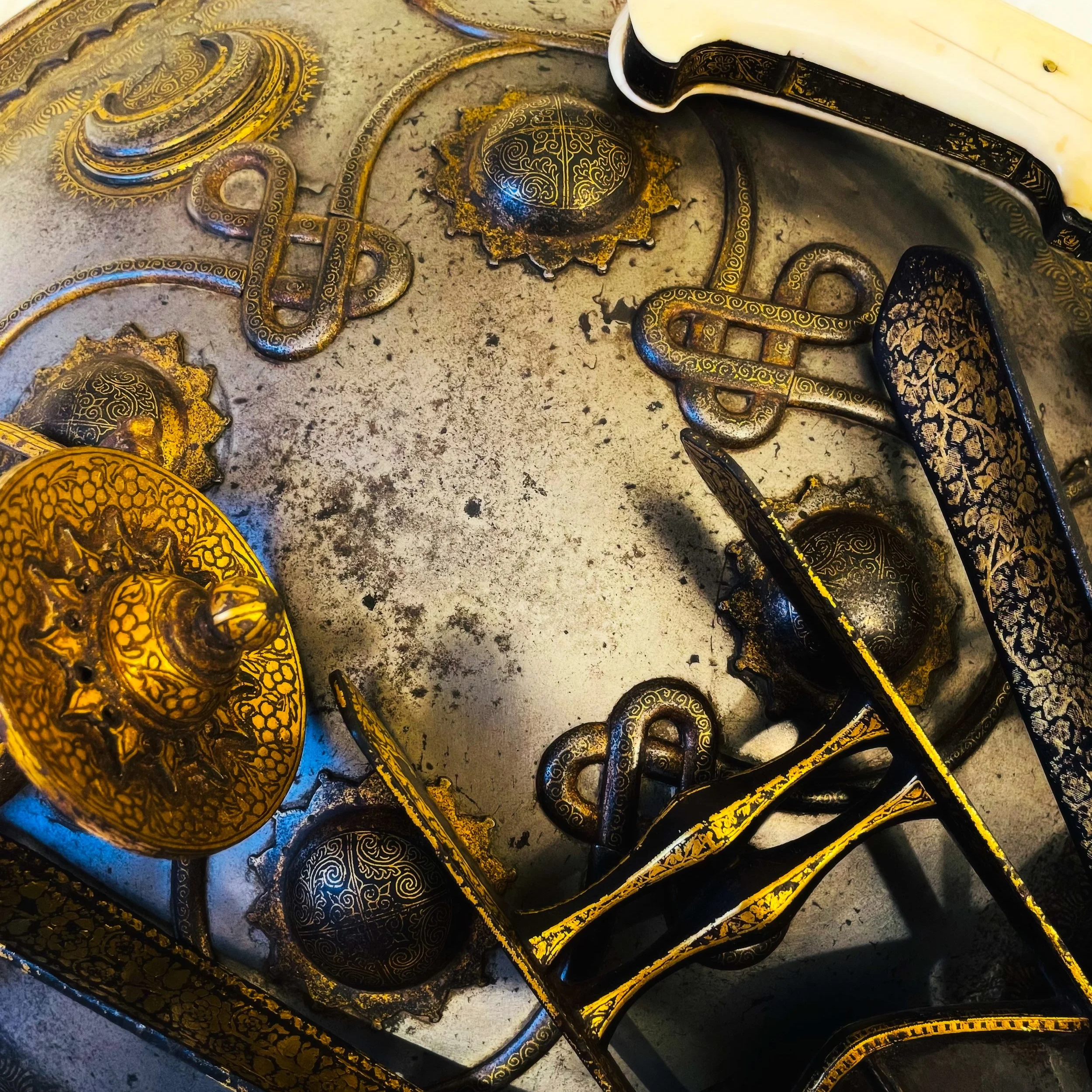
Figure 1: An example of appreciating, analysis and studying of the vast weapon types, styles and steels present in Indo-Persian arms and armour collecting
